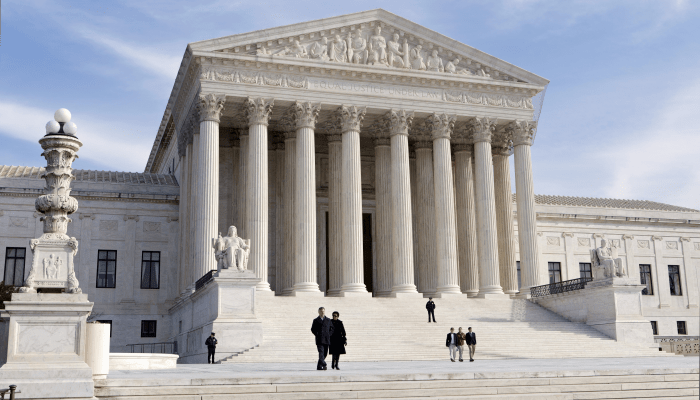
Photo credit: Andrew Glass, Supreme Court established as nation’s highest tribunal, Sept. 24, 1789, Politico (Sept. 24, 2018), https://www.politico.com/story/2018/09/24/this-day-september-24-1789-830087
Authored by Hannah Wood
Justice Kavanaugh’s concurrence in Dobbs v. Jackson Women’s Health Organization poised that the question of whether a state may “bar a resident of that State from traveling to another State to obtain an abortion” is not “especially difficult as a constitutional matter.”[1] For Justice Kavanaugh, the answer was simply “no” based on the “constitutional right to interstate travel.”[2] Yet, many states across the nation have introduced legislation to prosecute those who travel across state lines to obtain an abortion.
The Supreme Court’s decision in Dobbs triggered a nationwide explosion of legislation concerning access to abortions and reproductive care.[3] Anticipating the Dobbs opinion, thirteen states readied “trigger laws” to criminalize abortions as soon as Roe v. Wade was overturned.[4] And, contrary to Justice Kavanaugh’s view of the protections regarding interstate travel, some states, including Alabama, through these laws, are considering prosecuting individuals who travel outside their state to obtain a legal abortion.[5]
For example, Alabama’s Human Life Protection Act bans abortion at any stage of development, with no exceptions for rape or incest.[6] In response to the Act, organizations in Alabama designed to help women travel to obtain legal abortions, began to worry if their activity would subject them to criminal liability.[7] In addressing this, Attorney General Steve Marshall declared, “if someone was promoting themselves out as a funder of abortions out of state, that is potentially criminally actionable.”[8] While Marshall made clear that pregnant women could drive across “state lines and seek . . . an abortion in another place,” organizations and individuals who aid in such an act are fair game for criminal prosecution under conspiracy and accessory laws.[9]
Marshall’s statement motivated the Yellowhammer Fund, a non-profit organization providing aid to Alabamians for travel to obtain legal abortion care, to file suit against Marshall in his official capacity as Attorney General.[10] The Yellowhammer Fund’s complaint sought a legal ruling that the State of Alabama cannot prosecute individuals or organizations for providing financial, appointment, or travel assistance to Alabama residents who seek a legal abortion in another state.[11] In the complaint, the Yellowhammer Fund raised declaratory and injunctive claims, including the right to expression, association, travel, and freedom from extraterritorial application of state law.[12] Additionally, in their Motion for Summary Judgment, the Yellowhammer Fund argued that Alabama’s abortion ban cannot apply outside of the state and that violations of Alabama’s conspiracy or accessory laws are only applicable to abortions performed within Alabama.[13] In opposition, Marshall argued that since an abortion performed in Alabama is a crime, “a conspiracy formed in the State to have that same act performed outside the State is illegal.”[14]
Shortly after the parties’ initial arguments, the Department of Justice (DOJ) issued a Statement of Interest supporting the Yellowhammer Fund.[15] In that statement, DOJ rejected Marshall’s argument noting that conspiracy law does not empower a state attorney general to “impede interstate travel,” as it is wholly contrary to the constitutional right to travel.[16] DOJ also explained that “a state cannot bypass constitutional limits on its jurisdictional power by the simple expedient of using its conspiracy laws to purposefully interfere with conduct that other states have chosen to legalize.”[17]
This conclusion was similarly held by the United States District Court for the Middle District of Alabama who denied Marshall’s Motion to Dismiss.[18] The district court found that the Yellowhammer Fund had sufficiently alleged that “Marshall’s threats, if carried out, would violate the right to travel and the freedom of speech.”[19] Specifically, the court found that, “if a State cannot outright prohibit the plaintiff’s clients from traveling to receive lawful out-of-state abortions, it cannot accomplish the same end indirectly by prosecuting those who assist them.”[20] Accordingly, for the foreseeable future, organizations in Alabama may aid women in traveling to obtain legal abortions without fear of prosecution.
However, Alabama is not alone in pursuing such legislation. Bills that criminalize “abortion trafficking,” which targets adults aiding minors in procuring an abortion across state lines, were introduced in Tennessee and Idaho.[21] The recently enacted Tennessee bill criminalizes the “trafficking of a minor” for “procuring an act that would constitute a criminal abortion for [a] pregnant unemancipated minor,” and attempts to avoid right to travel restrictions by including “regardless of where the abortion is to be procured.”[22] Consequently, the law has been criticized by media for vagueness concerning the attempt to avoid the right to travel obstacle and jeopardizing freedom of speech.[23] In Idaho, a nearly identical “abortion trafficking” bill was met with similar criticism.[24] An Idaho judge invalidated the bill with an opinion criticizing “abortion trafficking is not a thing” because the procedure is legal in the other state.[25]
Therefore, with the perceived judicial trend leaning towards refusing to prosecute individuals who travel to obtain legal abortions, in-state prosecutions are coming into focus, and people are anticipating what types of evidence will support such prosecutions. For many, a rational place to start was data that is not protected by doctor-patient confidentiality or electronic data voluntarily given to apps. Online, women, including sociologist Gina Neff, began to advocate for deleting menstrual cycle tracking apps, worrying such data could be a prosecutorial gold mine prompting the tweet “delete those fertility apps now.”[26] This fear was well founded, as it is not uncommon for app companies to sell or provide information willingly to law enforcement.[27]
However, digital information stored in apps is not the only type of medical information at risk, as private medical records are also obtainable. Following Dobbs, many began investigating the extent of doctor-patient confidentiality and the Health Insurance Portability and Accountability Act’s (“HIPAA”) protection of medical records.[28] Commenting on this, Kayte Spector-Bagdady, a professor of bioethics and law at the University of Michigan, stated, “people think HIPAA protects a lot more health information than it actually does.”[29] HIPAA contains several exceptions regarding private health information, including disclosures required for law enforcement investigations or judicial proceedings.[30] However, some scholars, such as Cynthia Conti-Cook, a civil rights lawyer, have stressed the fears surrounding medical records and data are less concerning than evidence already used in criminal trials.[31] Cook points to the more obvious (and incriminating) evidence, like “the text to your sister that says, ‘Expletive, I’m pregnant,’” and the “search history for abortion pills or the visitation of websites that have information about abortion.”[32]
Accordingly, the prosecutorial landscape is simultaneously familiar and unknown, with each day bringing new legislation and judicial decisions. For now, though, it seems judges across the nation agree with Justice Kavanaugh’s proposition that whether a state may “bar a resident of that State from traveling to another State to obtain an abortion” is “not especially difficult as a constitutional matter.”[33] The resounding judicial response, just as Justice Kavanaugh predicted, is “no” based on the “constitutional right to interstate travel.”[34]
[1] 587 U.S. 215, 346 (2022) (J. Kavanaugh, Dissenting).
[2] Dobbs, 587 U.S. at 346.
[3] See Risa Kaufman et. al., Global impacts of Dobbs v. Jackson Women’s Health Organization and abortion regression in the United States, Nat’l Libr. of Med. 1, 1 (2022) https://www.ncbi.nlm.nih.gov/pmc/articles/PMC9673802/pdf/ZRHM_30_2135574.pdf (“In the immediate aftermath of the decision, states have rushed to eliminate abortion access, and the legal landscape has been chaotic, with the status of abortion rights changing daily.”)
[4] Jesus Jiménez & Nicholas Bogel-Burroughs, What are abortion trigger laws and which states have them? New York Times (2022), https://www.nytimes.com/2022/06/25/us/trigger-laws-abortion-states-roe.html
[5] Josh Moon, Alabama AG: State may prosecute those who assist in out-of-state abortions, Alabama Pol. Rep. (2022), https://www.alreporter.com/2022/09/15/alabama-ag-state-may-prosecute-those-who-assist-in-out-of-state-abortions/.
[6] Ala. Code § 26-23H-4; Alabama attorney says the state can prosecute those who help women travel for abortions, AP News (Aug. 31, 2023), https://apnews.com/article/alabama-abortion-steve-marshall-2157a7d0bfad02aad1ca41e61fe4de33 (“[Steve Marshall]’s office wrote that the Alabama Legislature categorized abortion as among the highest wrongs, ‘comparing it to murder’.”).
[7] See Alander Rocha, Health care providers sue Alabama officials over threats of prosecution in abortion aid, Louisiana Illuminator (Aug. 1, 2023), https://lailluminator.com/2023/08/01/health-care-providers-sue-alabama-officials-over-threats-of-prosecution-in-abortion-aid/ (“[B]anning abortion in Alabama seems to not have been enough, and those in power want to muzzle providers like me to prevent us from sharing information with our pregnant patients about the options they have.”).
[8] Josh Moon, Alabama AG: State may prosecute those who assist in out-of-state abortions, Alabama Pol. Rep. (2022), https://www.alreporter.com/2022/09/15/alabama-ag-state-may-prosecute-those-who-assist-in-out-of-state-abortions/.
[9] Id.
[10] Kim Chandler, Alabama health care providers sue over threat of prosecution for abortion help, AP News (July 31, 2023), https://apnews.com/article/abortion-alabama-lawsuit-9ed07274058a5fd79b5ba936b00a8380
[11] Id.
[12] Complaint at 29-36, Yellowhammer Fund v. Marshall, No. 2:23-CV-450, 2024 WL 1999546, *1 (M.D. Ala. May 6, 2024).
[13] Motion for Summary Judgment at 10, Yellowhammer Fund v. Marshall, No. 2:23-CV-450, 2024 WL 1999546, *1 (M.D. Ala. May 6, 2024).
[14] Motion to Dismiss at 2, Yellowhammer Fund v. Marshall, No. 2:23-CV-450, 2024 WL 1999546, *1 (M.D. Ala. May 6, 2024).
[15] DOJ Statement of Interest at 1-3, Yellowhammer Fund v. Marshall, No. 2:23-CV-450, 2024 WL 1999546, *1 (M.D. Ala. May 6, 2024).
[16] Id.
[17] Id.
[18] Yellowhammer Fund v. Marshall, No. 2:23-CV-450, 2024 WL 1999546, at *23-24 (M.D. Ala. May 6, 2024).
[19] Yellowhammer Fund, No. 2:23-CV-450, 2024 WL 1999546,at *23.
[20] Id. at *13.
[21] H.R. 1895, 113th Leg., (Tn. 2024); S.R. 1871 113th Leg., (Tn. 2024); Alanna Mayham, Idaho criminalizes helping minors to obtain abortions, Courthouse News Serv. (April 6, 2023), https://www.courthousenews.com/idaho-criminalizes-helping-minors-to-obtain-abortions/ (House Bill 242 – also called the “abortion trafficking” law – makes it illegal for any adult to assist a minor in obtaining abortion medication or a lawful abortion out of state without their parent’s consent.”).
[22] Id.
[23] See Angele Lathan, Concerns over free speech grow as abortion travel ban heads to Tennessee governor’s desk, The Tennessean (May 16, 2024), https://www.tennessean.com/story/news/politics/2024/05/16/free-speech-concerns-grow-tennessee-abortion-travel-ban-bill/73374657007/ (“[T]he criminal offense in [Tennessee’s] version applies to a much broader array of activity, and I think contributes to an even more concerning sense of vagueness.”); Catherine Sweeney, Feds want to shield medical records as Tennessee proposes travel bans for minor’s reproductive care, Nashville Pub. Radio (April 18, 2024), https://wpln.org/post/feds-want-to-shield-medical-records-as-tennessee-proposes-travel-bans-for-minors-reproductive-care/ (“We’ve never seen a court interpret ‘recruit or harbor’… we’re creating a mess around [] things that are pretty constitutionally protected … [t]ypically the government doesn’t regulate our conversations.”).
[24] Mary Anne Pazanowski, Idaho Can’t Enforce Abortion “Trafficking” Ban During Appeal, Bloomberg Law (Jan. 5, 2024), https://news.bloomberglaw.com/litigation/idaho-cant-enforce-abortion-trafficking-ban-during-appeal
[25] Id.; Memorandum Decision and Order, at 57, Matsumoto v. Labrador, No. 1:23-CV-000323, 2023 WL 7388852, at *23 (D. Idaho Nov. 8, 2023).
[26] See Kashmir Hill, Deleting Your Period Tracker Won’t Protect You, New York Times (June 30, 2022), https://www.nytimes.com/2022/06/30/technology/period-tracker-privacy-abortion.html (“When a draft of the court’s [Dobbs] decision was first leaked in May, and then when the ruling became official last week, people focused on these digital trails, specifically the information that millions of women share about their menstrual cycle on period tracker apps. The knee-jerk advice was simple and direct: Delete them all. Immediately.”).
[27] Rina Torchinsky, How period tracking apps and data privacy fit into a post-Roe v. Wade climate, National Pub. Radio (June 24, 2022), https://www.npr.org/2022/05/10/1097482967/roe-v-wade-supreme-court-abortion-period-apps (“It’s not uncommon for apps to cooperate law enforcement during criminal investigations.”).
[28] Eric Boodman, et. al, HIPPA won’t protect you if prosecutors want your reproductive health record, STAT (June 24, 2022), https://www.statnews.com/2022/06/24/hipaa-wont-protect-you-if-prosecutors-want-your-reproductive-health-records/.
[29] Id.
[30] Id.
[31] See Kashmir Hill, Deleting Your Period Tracker Won’t Protect You, New York Times (June 30, 2022), https://www.nytimes.com/2022/06/30/technology/period-tracker-privacy-abortion.html.
[32] Id.
[33] Dobbs v. Jackson Women’s Health Organization, 587 U.S. 215, 346 (2022) (J. Kavanaugh, Dissenting).
[34] Dobbs, 587 U.S. at 346.
 American Journal of Trial Advocacy