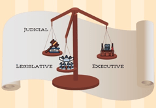
Photo Credit: Cara Halligan, Protecting Democracy Through Checks and Balances, The Hawk, https://sjuhawknews.com/36446/opinions/protecting-democracy-checks-balances/ (last visited Aug. 17, 2025).
Authored by: Bennett N. Vest
On June 27, 2025, the Supreme Court addressed the issue of whether federal district courts could issue universal injunctions in Trump v. Casa, Inc.[1] In a 6-3 decision, authored by Justice Barrett, the Court reversed the courts of appeals and granted the government’s applications for partial stays because (1) the government was likely to succeed on the merits that universal injunctions were beyond the power of federal courts under the Judiciary Act and (2) that the government showed a likelihood of irreparable harm.[2]
On January 20, 2025, President Trump issued an executive order revoking automatic birthright citizenship for children born in the United States with alien parents.[3] Almost as soon as President Trump signed the order, many states and groups filed for universal injunctions in federal district courts to stop the President from enforcing the executive order.[4] Three district courts issued universal injunctions against the executive branch and the president, and the court of appeals denied the government’s partial petition to stay.[5] The Supreme Court heard oral arguments on the case after the government filed emergency appeals.[6]
District courts issuing universal injunctions are relatively new, but they have become increasingly popular since George W. Bush’s presidency. [7] They block the executive branch from implementing its own policies that are “unconstitutional.”[8] In the first one hundred days of President Trump’s second term, 25 universal injunctions were issued against President Trump and the Executive Branch.[9] Under the Judiciary Act, federal courts have power over cases “in equity,” but the question is whether universal injunctions are included as part of their equitable powers.[10]
Without addressing the substance of the executive order, the majority opinion only addressed the power of federal district courts to issue universal injunctions.[11] Under a historical analysis, the majority opinion rejected the dissents arguments that universal injunctions (1) have a historical basis in American law, (2) provide complete relief for parties, and (3) serve “important policy objectives.”[12] Going back to the Court of Chancery in England, the majority opinion concluded that universal injunctions were not historically part of our system of law.[13] Moreover, our current system distinguishes complete relief from universal relief by providing aggregated relief in the form of class action lawsuits or formerly Bills of Peace in England.[14] Therefore, the government proved that it was likely that the Judiciary Act did not include universal injunctions as a form of equitable relief.
To grant the partial stays for the government, the government also had to provide enough evidence to suggest that the executive branch was likely to suffer “irreparable harm” if the stay was not granted.[15] The Court ruled that universal injunction by itself causes irreparable harm because it cannot enforce its own policies.[16]
Justice Thomas, Alito, and Kavanaugh wrote separate concurring opinions, with Justice Gorsuch joining Justice Thomas’ concurrence and Justice Thomas joining Justice Alito’s concurrence.[17] Justice Thomas advocated for a “plaintiff-specific injunction” while Justice Alito focused on third-party standing and class certification.[18] Finally, Justice Kavanaugh’s concurrence focused on the Supreme Court’s power to rule on such injunctions and equitable relief.[19] In opposition to the majority’s ruling, Justice Sotomayor, joined by Justice Kagan and Jackson, and a separate dissent by Justice Jackson, uphold universal injunctions as an appropriate equitable remedy, but the majority of the dissenting opinions focus on the substance of the executive order.[20]
This ruling comes at a time where the concept of federalism and the power of the presidency are constantly being challenged by President Trump. To date, President Trump is on pace to set a record number of executive orders during his second term.[21] These orders have caused disagreements amongst his “political enemies” over politics and policy, and these battle are being played out in venues favorable to the Plaintiffs, resulting in universal injunctions being granted.[22] As a result of “weaponizing the courts,” there is increasing skepticism that the courts are not impartial but rather that they impose their own political beliefs.[23] Even some members of the Supreme Court have made these accusations of their own colleagues by stating their recent rulings favor of President Trump.[24]
Beyond Casa, the question remains whether Executive Order 14160 is constitutional. Justice Barrett and the other justices joining the majority opinion did not opine or indicate how it would rule on that issue, but the dissenting opinions make it clear that they believe President Trump and the executive branch overstepped their constitutional bounds.[25] It is plausible that the Court would rule that Executive Order 141460 exceeds constitutional bounds in the future. However, the Casa decision limited district courts’ powers to issue universal injunctions. It does not suggest that district courts cannot rule that executive orders are unconstitutional, but that the remedy needs to be more specific or tailor to the person or persons seeking the relief. With the Supreme Court defining the powers of federal courts, the hope is that courts will not be used as much for favorable rulings and the three branches of government can operate more effectively within their defined constitutional powers.
[1] See 145 S. Ct. 2540 (2025).
[2] See id. at 2549.
[3] Exec. Order No.14160, 90 Fed. Reg. 8449 (Jan. 20, 2025) (restricting birthright citizenship when “(1) when that person’s mother was unlawfully present in the United States and the father was not a United States citizen or lawful permanent resident at the time of said person’s birth, or (2) when that person’s mother’s presence in the United States at the time of said person’s birth was lawful but temporary (such as, but not limited to, visiting the United States under the auspices of the Visa Waiver Program or visiting on a student, work, or tourist visa) and the father was not a United States citizen or lawful permanent resident at the time of said person’s birth”).
[4] See Mike Catalini, 22 States Sue to Stop Trump’s Order Blocking Birthright Citizenship, AP News (Jan. 21, 2025), https://apnews.com/article/birthright-citizenship-trump-executive-order-immigrants-fc7dd75ba1fb0a10f56b2a85b92dbe53.
[5] See Casa, Inc. v. Trump, 763 F. Supp. 3d 723 (D. Md. 2025); Washington v. Trump, 765 F. Supp.3d 1142 (W. D. Wash. 2025); Doe v. Trump, 766 F.Supp.3d 266 (D. Mass 2025).
[6] See Casa, Inc., 145 S. Ct. at 2540.
[7] See id. at 2553 (stating that universal injunctions were not used until the 20th century).
[8] Id. at 2548.
[9] See Joanna R. Lampe, Nationwide Injunctions in the First Hundred Days of the Second Trump Administration, Congressional Research Service (updated May 16, 2025)https://www.congress.gov/crs-product/R48476.
[10] See Casa, Inc., 145 S. Ct. at 2551.
[11] See id. at 2562-63.
[12] Id. at 2554.
[13] See id. at 2551.
[14] See id. at 2555.
[15] Id. at 2562.
[16] See Casa, Inc., 145 S. Ctat 2562.
[17] See id. 145 S. Ct. at 2563 (Thomas, J., concurring); Casa, Inc., 145 S. Ctat 2565 (Alito, J., concurring); Casa, Inc., 145 S. Ctat 2567 (Kavanaugh, J. concurring).
[18] See Casa, Inc., 145 S. Ct. at 2565.
[19] See id. at 2567.
[20] See id. at 2574 (Sotomayor, J. dissenting); Casa, Inc., 145 S. Ctat 1596 (Jackson, J., dissenting).
[21] See Bert Jensen, Everything’s an ‘Emergency’: How Trump’s executive order record pace is testing the courts, USA Today, (April 5, 2025), https://www.usatoday.com/story/news/politics/2025/04/05/trump-executive-orders-lawsuits-emergencies/82792612007/.
[22] See Katrina Kaufman & Matt Clark, The Courts Where Nationwide Injunctions are Originating, CBS News (May 15, 2025, 11:12 P.M.), https://www.cbsnews.com/news/courts-nationwide-injunctions-originating/.
[23] See Benedict Vigers & Lydia Saad, Americans Pass Judgement on Their Courts, Gallup (Dec. 16, 2024), https://news.gallup.com/poll/653897/americans-pass-judgment-courts.aspx.
[24] Trump v. U.S., 603 U.S. 593, 684 (2024) (highlighting that Justice Sotomayor stated that the majority’s opinion made the president “a king above the law”).
[25] See Casa, Inc.,145 S. Ct. at 2674.
 American Journal of Trial Advocacy