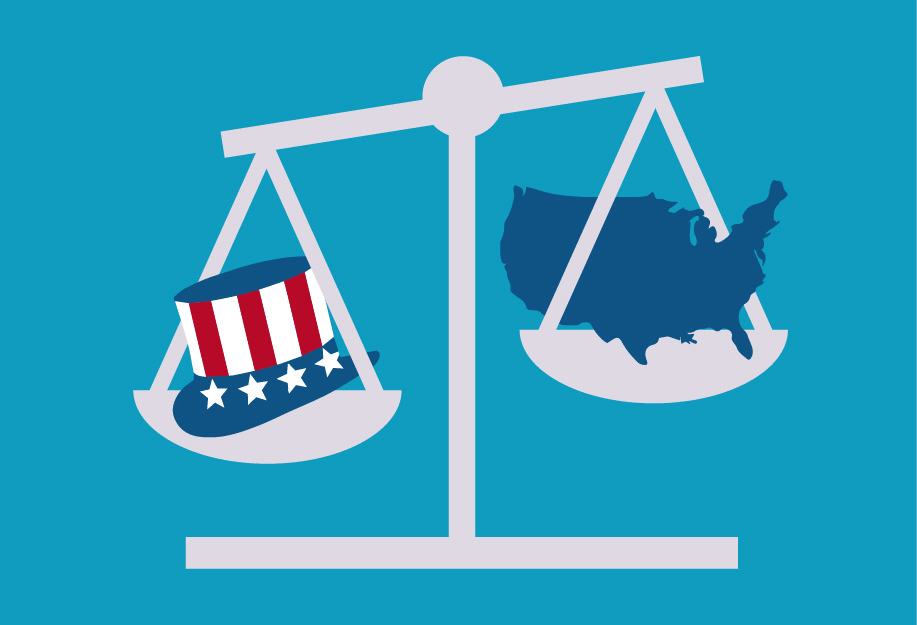
Photo Credit: Federal Laws Versus State Laws (illustration), in Federal Laws Versus States Rights Re-Visited, USRESISTNEWS.ORG (Jan. 1, 2022), https://www.usresistnews.org/2022/01/04/federal-laws-versus-states-rights-re-visited/.
Authored by: Mary-Michael Rhodes
I. Introduction
On December 8, 2025, the Supreme Court issued a concise, per curiam opinion in Doe v. Dynamic Physical Therapy, LLC addressing the limits of a state’s authority to confer civil immunity where a plaintiff asserts claims arising under federal law.[1] Although the opinion itself is brief, the Court’s holding clarifies an important constitutional boundary regarding the relationship between state-created immunities and federally created causes of action. Specifically, the Court reaffirmed that while states retain broad authority to define liability under their own laws, they lack the power to immunize defendants from liability imposed by federal statutes.[2]
This decision is significant not because it announces a new doctrinal framework, but because it reinforces long-standing Supremacy Clause principals in a legal landscape increasingly shaped by expansive state immunity statutes. In recent years, particularly following the COVID-19 public health emergency, states have enacted sweeping liability shields designed to protect health care providers, emergency responders, and private entities operating under extraordinary conditions. Doe makes clear that such statutes may validly restrict state-law causes of action, but they cannot operate to bar federal claims, even when those claims are litigated in state court.[3]
As a result, Doe serves as a reminder that federal statutory rights occupy a distinct constitutional space. When Congress creates a federal cause of action, that cause of action must be adjudicated according to federal standards, free from state legislative interference that would otherwise undermine uniform enforcement.
II. Background of the Case
Doe arose out of a civil action brought against a Louisiana physical therapy clinic.[4] The plaintiff asserted claims under federal disability discrimination law, alleging that the clinic engaged in discriminatory conduct during the course of providing health care services.[5] In response, the clinic invoked a Louisiana statute enacted during a declared public health emergency which conferred civil immunity on certain health care providers for actions taken in connection with emergency-related services.[6]
The Louisiana Court of Appeals treated the immunity statute as a categorical bar to liability.[7] Importantly, the state court did not limit the statute’s application to state law claims; rather, it concluded that the immunity provision foreclosed all civil claims arising from the alleged conduct, including those grounded in federal law.[8] Under that reasoning, the source of the plaintiff’s rights—whether state or federal—was immaterial so long as the conduct occurred within the temporal and substantive scope of the state immunity statute.[9]
The United States Supreme Court reversed, rejecting the premise that a state legislature may define the reach of federal law by expanding the scope of immunity beyond state causes of action.[10] The Court emphasized that while Louisiana was free to limit liability under its own laws, it could not dictate the enforceability of rights created by Congress.[11]
III. The Supreme Court’s Holding
The Supreme Court framed the issue in direct and unambiguous terms. While acknowledging that “[d]efining the scope of liability under state law is a State’s prerogative,” the Court held that “a State has no power to confer immunity from federal causes of action.”[12] The Louisiana Court of Appeals therefore erred by applying a state immunity statute to dismiss claims arising under federal law.[13]
Notably, the Court declined to address the underlying merits of the plaintiff’s federal claims. Rather, it observed that those claims “may well fail on other federal grounds” and remanded the case so that the state court court address the federal issues in the first instance.[14] In doing so, the Court cited Cummings v. Premier Rehab Keller, P.L.L.C. as an example of how federal law itself may limit available remedies in certain statutory discrimination actions.[15]
This aspect of the opinion is critical. Doe does not expand federal liability or guarantee recovery for plaintiffs. Instead, it preserves the required order of analysis. Federal claims must be evaluated under federal law, even if they ultimately fail.[16] What states may not do is bypass that inquiry by invoking state law immunity as a threshold bar at the outset of the case.[17]
IV. The Constitutional Limits on State-Created Immunity
The holding in Doe rests squarely on the Supremacy Clause, which provides that federal law “shall be the supreme Law of the Land.”[18] Under this framework, state courts are required to apply federal law when adjudicating federal claims, regardless of contrary state statutes or policies.
The Supreme Court has repeatedly addressed this issue in prior cases. In Howlett v. Rose, the Court held that a state law sovereign immunity defense could not defeat a federal civil rights claim brought in state court.[19] Once Congress creates a federal cause of action, the Court explained, the elements, defenses, and scope of that claim are matters of federal law.[20] A state may not alter those features by invoking its own immunity doctrines.
Similarly, in Haywood v. Drown, the Court invalidated a state statute that effectively stripped state courts of jurisdiction over certain damages actions against corrections officers.[21] Although the statute did not explicitly target federal claims, its practical effect was to discriminate against federal civil rights actions, thereby violating the Supremacy Clause.[22]
More recently, the Court reaffirmed this principle in Williams v. Reed, where it rejected a state procedural scheme that created a “catch-22” preventing plaintiffs from ever bringing certain federal claims.[23] Even though the state framed the scheme as a neutral exhaustion requirement, the court held that states may not use procedural devices to accomplish indirectly what they cannot do directly: immunize defendants from federal liability.[24]
Doe fits neatly within this line of cases. Whether labeled as “immunity,” “jurisdiction,” or “procedure,” state rules that function to extinguish federal causes of action are incompatible with federal supremacy.
V. Practical Implications for Legislatures and Litigants
The Court’s decision in Doe carries meaningful implications for both state legislatures and civil litigants. First, it reinforces that immunity statutes require careful limitation and should not be broadly construed. While states may validly restrict state law tort liability, those restrictions must not be drafted or applied in a manner that reaches federal claims.[25]
Second, the decision reinforces the role of state courts as forums for the enforcement of federal rights. State courts possess concurrent jurisdiction over many federal causes of action and with that jurisdiction comes a constitutional obligation to apply federal law faithfully. A state court may dismiss a federal claim for lack of standing, failure to state a claim, or other valid federal grounds, but it may not rely on state law immunity as the basis for dismissal.[26]
Third, Doe has particular relevance in areas such as health care regulation, emergency response, and privatized public services. As states continue to experiment with liability-limiting statutes to address perceived litigation burdens, Doe serves as a caution that those statutes cannot override federally protected rights.
VI. Conclusion
Although brief, Doe v. Dynamic Physical Therapy, LLC reaffirms a foundational principle of constitutional law: states may define the scope of liability under their own laws, but they may not confer immunity from federal causes of action.[27] In doing so, the Supreme Court preserved the supremacy and uniform application of federal law while respecting the traditional authority of states to regulate state law claims.
For courts and litigants alike, Doe provides clear guidance. When a plaintiff asserts a claim arising under federal law, that claim must rise or fall on federal grounds alone.[28] State-created immunities, however broadly framed, cannot stand as a barrier to the enforcement of federal rights.[29]
[1] Doe v. Dynamic Physical Therapy, LLC, 223 L. Ed. 2d 222, 223 (2025).
[2] Id.
[3] Id.
[4] Doe v. Dynamic Physical Therapy, LLC, 404 So. 3d 1008, 1011 (La. Ct. App. 2024), rev’d, 223 L. Ed. 2d 222 (2025).
[5] Id.
[6] Id. at 1013-14.
[7] Id. at 1014-16.
[8] Id. at 1017-18.
[9] Id. at 1018.
[10] Doe v. Dynamic Physical Therapy, LLC, 223 L. Ed. 2d 222, 223 (2025).
[11] Id.
[12] Id.
[13] Id.
[14] Id.
[15] Id. (citing Cummings v. Premier Rehab Keller, P.L.L.C., 596 U.S. 212, 222 (2022)).
[16] Doe, 223 L. Ed. 2d at 223.
[17] Id.
[18] U.S. Const. art. VI, cl. 2.
[19] 496 U.S. 356, 383 (1990).
[20] Id. at 376 (citing Owen v. Independence, 445 U.S. 622, 647 n. 30 (1980)).
[21] 556 U.S. 729, 736 (2009).
[22] Id. at 741-42.
[23] 604 U.S. 168, 170 (2025).
[24] Id. at 177.
[25] Doe, 223 L. Ed. 2d at 223; Howlett v. Rose, 496 U.S. 356, 383 (1990); Haywood, 556 U.S. at 740; Williams, 604 U.S. at 174.
[26] Doe, 223 L. Ed. 2d at 223.
[27] Id.
[28] Id.
[29] Id.
 American Journal of Trial Advocacy