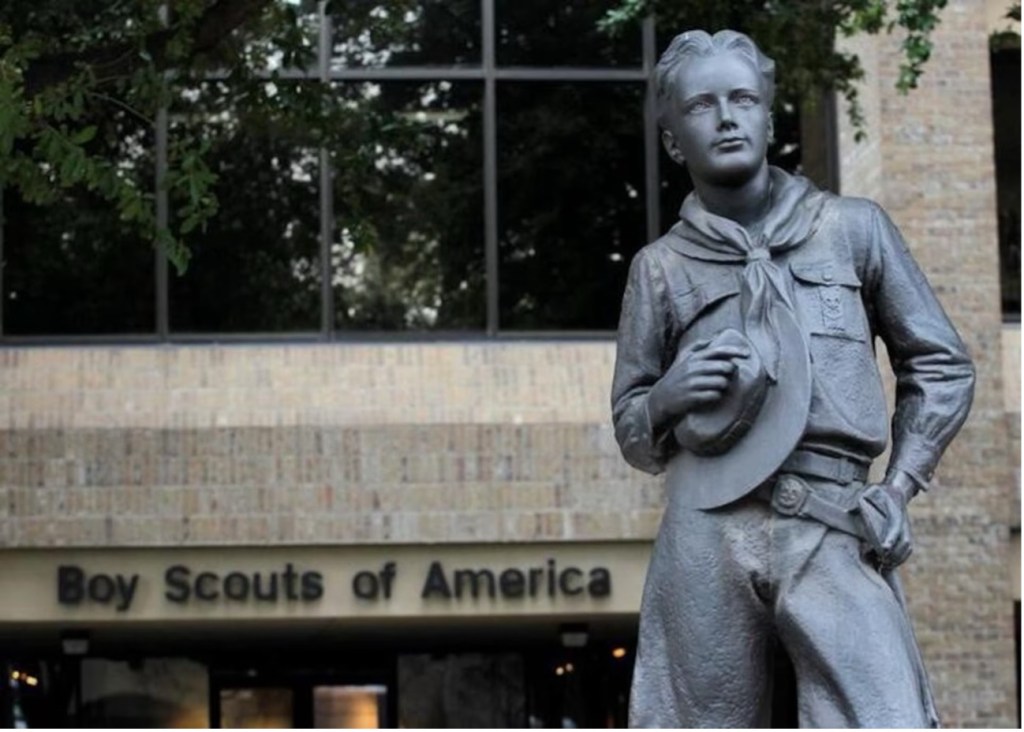
Photo Credit: Dietrich Knauth, Boy Scouts Abuse Settlement Faces Questions As US Supreme Court Weights Purdue Appeal, Reuters (September 13, 2022, https://www.reuters.com/legal/litigation/boy-scouts-abuse-settlement).
Authored by Benjamin C. Parker
What if the Court blows the whistle only to find the game’s already over? That’s the paradox underlying the Boy Scouts of America settlement.
The United States Supreme Court’s denial of certiorari in the Boy Scouts case highlights a clash of timing and finality.[1] Even after its 2024 decision in Purdue Pharma rejecting nonconsensual third-party releases, the Court declined to review a plea by a small group of sexual-abuse victims whose claims were released without their consent.[2] For the victims, the plan doesn’t bring closure; it reads as forced finality. To see why, let’s start with the basics of bankruptcy.
Bankruptcy Basics
Chapter 11 is the federal bankruptcy system’s tool for managing overwhelming liabilities while permitting an organization to keep operating.[3] Once the debtor files, the automatic stay is triggered, acting as a pause button that halts lawsuits, collections, evictions, repossessions, etc.[4]
The debtor will then propose a plan in an effort to consolidate large groups of creditors into a single process with the goal of a court-approved resolution.[5] In bankruptcy cases with mass tort claimants, the plan often creates a settlement trust funded by multiple contributors to compensate victims.[6] This offers many advantages because it can help avoid thousands of separate lawsuits that each have different complexities, timelines, and expenses.[7] Instead, bankruptcy offers one collective process with the goal of distributing value efficiently, consistently, and as equitably as possible.[8] But the same “binding” power that makes bankruptcy effective is also where the controversy lives.
The Release Problem
The story is familiar for the typical chapter 11 bankruptcy. The debtor files a petition, creditors vote in classes, the court confirms a plan, and the debtor gets a discharge.[9] The discharge eliminates many prepetition claims against the debtor and bars any later pursuit of them.[10]
A third-party release goes further. It essentially insulates certain non-debtors – owners, affiliates, local councils, chartering organizations – because the plan releases them too.[11] Supporters maintain that without the releases, the real money does not materialize.[12] Since non-debtors can generally achieve “global peace” through these tools, they are more willing to contribute to the trust in exchange for broad releases.[13] On the other hand, critics see a more unsettling reality – in particular, concerning nonconsensual third-party releases. Opponents maintain that such releases violate the Bankruptcy Code, bankruptcy policy, as well as the constitutional right to due process.[14]
In the sexual-abuse context, the objection isn’t merely about money. Many victims want accountability, discovery, and their day in court against specific organizations rather than compensation through a trust.[15] As a result, broad releases are viewed as negotiated bulk deals for immunity instead of true justice.[16] The fight over who has the power to impose releases on nonconsenting creditors reached the Supreme Court in Purdue Pharma.
Purdue: the Supreme Court Changes the Rule
The Purdue bankruptcy was rooted in a familiar mass-tort structure. In short, the proposed plan sought to resolve massive opioid liability through contributions tied to broad releases.[17] However, the plan was controversial as it sought releases for the Sackler family, non-debtors, over the objections of non-consenting claimants.[18]
In June of 2024, the Supreme Court held that bankruptcy courts generally lack authority under the Bankruptcy Code to enforce nonconsensual third-party releases.[19] The decision was effectively a major reset button.[20] Put simply, if you don’t file for bankruptcy, a bankruptcy court may not force people to release claims against you without their consent.[21] Following this reset, many are left scratching their heads. If Purdue closed the door on nonconsensual third-party releases, why didn’t that kill the Boy Scouts plan?
Boy Scouts: A Deal That Survives Anyway
Boy Scouts of America filed for chapter 11 bankruptcy in the face of thousands of sexual-abuse claims made over multiple decades.[22] The confirmed plan included a settlement trust as well as protections for certain non-debtors who contributed funds.[23] Such non-debtors included local councils, chartered organizations and other affiliated bodies within the Scouting ecosystem.[24]
On one side, plan proponents emphasized the advantages of settlement in the mass-tort setting. These advantages include speed, certainty, and money now.[25] Without settlement, it would have taken the victims years, maybe even decades of litigation to achieve justice.[26] They argued the trust could deliver quick, equitable compensation and help avoid ruinous costs of fighting thousands of different cases across jurisdictions.[27]
On the flip side, objectors like the Lujan Claimants raised fairness concerns. They argued that since harm is profound and personal, it could not be rectified through a lump-sum payout.[28] Despite compensation from a trust, losing the right to sue felt like a loss of agency and an inability to hold certain parties accountable.[29] To the plan opponents, it felt like a victim fairness problem; the settlement was financially meaningful but emotionally destabilizing when it extinguished claims against non-debtors without consent.[30]
The Boy Scouts plan didn’t survive because Purdue didn’t matter, it survived because timing and finality mattered more.
Finality Over New Rules
Often, the Supreme Court declining to review a case is misunderstood. Denial of certiorari isn’t a stamp of approval.[31] It is usually just the Court’s refusal to take up the issue.[32] With that said, the practical effect can be just as powerful.[33] For instance, if a lower court ruling remains in place, the settlement remains in place.
For the non-consenting victims, this is where finality takes over. Bankruptcy is built on the idea that at some point, a confirmed plan becomes stable enough that unwinding it would generate more harm than good.[34] Once a plan has been substantially implemented to where money is moving, the trust is up and running, and distributions are underway, courts are generally hesitant to pull the rug out.[35] This isn’t because the plan is perfect but has more to do with the systemic chaos that would ensue in the alternative.[36] This can come in the form of clawbacks, delays, and fresh rounds of litigation, as well as the risk that those waiting for distributions are pushed into limbo.[37]
The bottom line: Purdue reshaped the doctrine going forward, but Boy Scouts was “final enough” that the system chose stability over reopening the fight.[38] Although the law moved, the settlement did not.[39]
This is the timing trap.[40] In mass-tort bankruptcies, finality can often win.[41] This is not because fairness is irrelevant but has more to do with a system that favors certainty.[42] That certainty would be undermined by unwinding a plan that had already distributed funds to roughly 80,000 victims.[43] Once a deal as big as Boy Scouts is in motion, courts are reluctant to stop it.
What’s Still In the Air After Purdue and Boy Scouts?
The story doesn’t end with a closed courthouse door. Instead, it merely changes where the next challenge will happen. A few questions at the forefront of the conversation:
- What counts as real consent after Purdue? If nonconsensual releases are generally off the table, do plans pivot to opt-in structures or rely on voting mechanics functioning like consent for most?[44] Do the hard questions stay in the margins?[45]
- Will parties find loopholes in different settlement structures to mimic the releases? Despite a label change, global peace will likely be pursued through creative drafting.[46] Expect more channeling mechanisms and settlement structures designed to recreate release-like protection without using the term.
- Is Congress up to bat for creating a broader mass-tort pathway? Asbestos already has its own statutory framework, while other mass-tort bankruptcies do not.[47] If courts no longer have authority under the code to impose the nonconsensual releases, pressure increases for a legislative solution.
Conclusion
In the end, Boy Scouts shows what happens when the rulebook changes after the last play. Purdue narrowed the power to impose nonconsensual third-party releases going forward, but finality kept an already-implemented plan on the field. As a result, some victims see it as resolution while others feel coerced closure. Such tension doesn’t seem to be going anywhere unless Congress steps in with a clearer framework. Until then, the system will keep facing a tough question: how much peace can bankruptcy buy, and who gets to decide the price?
[1] Lujan Claimants v. Boy Scouts of Am., No. 25-490, 2026 WL 79599, at *1 (U.S. Jan. 12, 2026) (denying the petition for writ of certiorari).
[2] Id.; Harrington v. Purdue Pharma L. P., 603 U.S. 204, 226 (2024) (holding that in a chapter 11 reorganization, the Code does not authorize an injunction and release that would practically extinguish claims against a nondebtor without the affected claimants’ consent).
[3] Chapter 11 – Bankruptcy Basics, United States Courts, (February 9, 2026), https://www.uscourts.gov/court-programs/bankruptcy.
[4] Id.
[5] Id.
[6] Luke A. Barefoot et. al, Discharge of Mass Tort Liability, Due Process & Illusory Finality in Chapter 11, Bloomberg Law, (August 2022), https://www.bloomberglaw.com/ bankruptcy-professional-discharge (explaining the defined set of eligibility and valuation criteria for claimants).
[7] Id.
[8] Id.
[9] Jane Furigay Shapiro, Understanding the Chapter 11 Plan, Daily DAC: Distressed Asset Central, (February 2, 2026), https://www.dailydac.com/understanding-the-chapter-11-plan.
[10] Id.
[11] Jason Blanchard, Opt-in or opt-out? The ongoing debate over consensual third-party releases in Chapter 11 cases, Norton Rose Fulbright, (Q2, 2025), https://www.nortonrosefulbright.com/opt-in-or-opt-out.
[12] Id. (highlighting the incentivization of non-debtors, increase in value to the bankruptcy estate, and protection from future litigation).
[13] Id.
[14] Henry Reynolds, Third-Party Bankruptcy Releases and the Separation of Powers: A Stern Look, 40 Emory Bankr. Dev. J. 111 (2024).
[15] Alexandra Jones, Sex abuse victims fight to thwart Boy Scouts’ $2.4 billion bankruptcy payout plan, Courthouse News Service, (November 6, 2024), https://www.courthousenews.com/sex-abuse-victims-fight.
[16] Id.
[17] Danielle Kaye, Bankruptcy judge clears $7.4bn Purdue Pharma opioid settlement, BBC, (November 25, 2025), https://www.bbc.com/news/articles.
[18] Dylan Trache, Purdue Pharma Plan Blocked, Supreme Court Bars Third-Party Releases in Bankruptcy, Nelson Mullins, (July 1, 2024), https://www.nelsonmullins.com/insights/blogs/red-zone/chapter_11_plans/purdue-pharma-plan-blocked-supreme-court-bars-third-party-releases-in-bankruptcy.
[19] Purdue Pharma, 603 U.S. at 218 (“[W]e do not think paragraph (6) affords a bankruptcy court the authority the [Sacklers] propose.”).
[20] Purdue Pharma: Supreme Court Rejects Nonconsensual Third-party Releases, Squire Patton Boggs, (July 2024), https://www.squirepattonboggs.com/insights/publications/purdue-pharma-supreme-court-rejects-nonconsensual-third-party-releases.
[21] Id.
[22] In re Boy Scouts of Am. & Delaware BSA, LLC, 650 B.R. 87, 104 (D. Del. 2023), aff’d in part, rev’d in part, dismissed in part sub nom. In re Boy Scouts of Am., 137 F.4th 126 (3d Cir. 2025).
[23] Id. at 110.
[24] Id. at 106.
[25] Geoff Mulvihill, Here’s what’s in the opioid settlement against OxyContin maker Purdue and the Sackler family, The Seattle Times, (November 18, 2025), https://www.seattletimes.com/business/judge-to-explain-why-hes-approving-purdue-pharma-settlement-plan-which-calls-for-7b-from-sacklers.
[26] Id.
[27] Id.
[28] Brown Rudnick Helps Secure Key Supreme Court Ruling for Boy Scouts Bankruptcy Deal, brown rudnick, (February 26, 2024), https://brownrudnick.com/client_news/brown-rudnick-helps-secure-key-supreme-court-ruling-for-boy-scouts-bankruptcy-deal.
[29] Id.
[30] Id.
[31] Supreme Court Procedures, United States Courts, (last visited February 9, 2026), https://www.uscourts.gov/about-federal-courts/educational-resources/about-educational-outreach/activity-resources/supreme-court-procedures.
[32] Id.
[33] Donald Swanson, Does A U.S. Supreme Court’s Certiorari Denial Have Precedential Value?, Mediatbankry, (December 11, 2025), https://mediatbankry.com/2025/12/11/does-a-u-s-supreme-courts-certiorari-denial-have-precedential-value.
[34] See supra note, 3.
[35] Alex Wolf, Boy Scouts Bankruptcy Plan, Abuse Deal Avoids High Court Review, Bloomberg Law, (January 12, 2026), https://news.bloomberglaw.com/bankruptcy-law/boy-scouts-bankruptcy-plan-abuse-deal-avoids-high-court-review.
[36] Id.
[37] Id.
[38] John Fritze, Supreme Court leaves multi-billion dollar Boy Scouts bankruptcy settlement in place, CNN, (January 12, 2026), https://www.cnn.com/2026/01/12/politics/boy-scouts-supreme-court-settlement.
[39] Id.
[40] See supra, note 15 (highlighting the “temporal happenstance” and “bitter pill to swallow” of the Supreme Court’s decision to deny certiorari).
[41] Id.
[42] Id.
[43] See supra, note 40 (observing that only 144 of the roughly 82,000 were seeking to appeal).
[44] Seth Lieberman, Making Sense of Consent: Third-Party Releases Post-Purdue, Pryor Cashman, (September 22, 2025), https://www.pryorcashman.com/publications/making-sense-of-consent-third-party-releases-post-purdue.
[45] Id. (discussing the jurisdictional preferences of opt-ins, opt-outs, and hybrid releases).
[46] Ben Zigterman, Purdue Release Ruling May Spur Creative Ch. 11 Workarounds, Law 360: Bankruptcy Authority, (July 22, 2024), https://www.law360.com/bankruptcy-authority/articles/1860763/purdue-release-ruling-may-spur-creative-ch-11-workarounds.
[47] Shrader & Associates, The Impact of Bankruptcy on Asbestos Lawsuits, Shrader & Associates, L.L.P. National Trial Attorneys, (February 5, 2026), https://shraderlaw.com/blog/asbestos-exposure/bankruptcy-asbestos-lawsuits.
 American Journal of Trial Advocacy