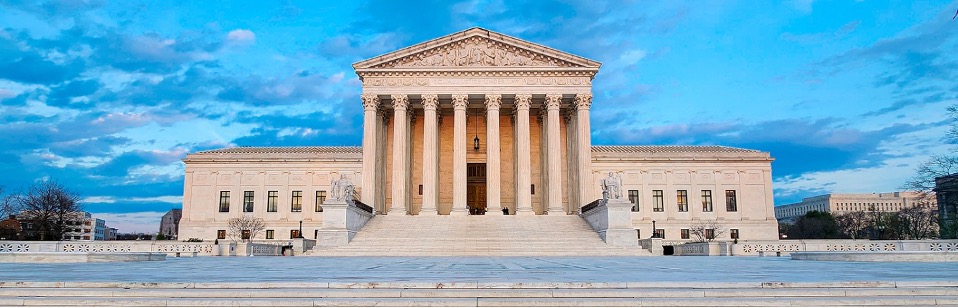
Photo Credit: Supreme Court of the United States – Washington DC USA, https://supreme.justia.com/ (last visited Feb. 2, 2026).
Authored by: Arielle H. Foster
For nearly thirty years, the Antiterrorism and Effective Death Penalty Act of 1996 (“AEDPA”) has functioned as a formidable procedural obstacle, shielding criminal convictions from judicial review under the guise of finality.[1] While the Supreme Court has spent much of the last decade reinforcing these barriers for state prisoners, its recent decision in Bowe v. United States indicates a critical breach in the gatekeeping wall, a breach that appears to be built on textualism, rather than judicial policy.[2] In a 5-4 ruling, the Court clarified that federal prisoners are not subject to the “same-claim” bars that ultimately lock the courthouse doors for their state counterparts.[3] For the trial advocate, Bowe is more than a technical victory within post-conviction procedures; it is also a vital reminder that the specific linguistic choices of Congress can in fact preserve a “second bite at the apple” for thorough practitioners.
Michael S. Bowe, the petitioner, found himself caught in the rapidly evolving federal sentencing process. Bowe was serving a 24-year sentence following a 2008 guilty plea, a term that was anchored by a mandatory 10-year consecutive “stacking” penalty under 18 U.S.C. § 924(c) for using a firearm during an “attempted Hobbs Act robbery.”[4] As the Court narrowed the definition of “crime of violence” in cases like United States v. Davis and United States v. Taylor, Bowe sought to challenge his sentence, arguing that the underlying conduct of his crime no longer supported that firearm sentencing enhancement.[5] However, the Eleventh Circuit acted as an impenetrable gatekeeper, applying the “same-claim” bar from 28 U.S.C. § 2244(b)(1), a provision that usually mandates the dismissal of claims that were already presented in a prior petition.[6] The Eleventh Circuit’s logic prioritized the gatekeeping functions of the AEDPA, suggesting that the statutory interest in finality precludes defendants from reopening sentences even when the underlying legal landscape undergoes a significant transformation.[7]
The Supreme Court’s reversal hinged on a precise, textualist distinction between two categories of defendants: (1) state prisoners filing “applications” under § 2254; and (2) federal prisoners filing “motions” under § 2255.[8] The Court started by addressing its own power to hear the case, more specifically, whether the “certiorari bar” found in § 2244(b)(3)(E) applied to federal prisoners.[9] Invoking the “clear statement” rule, the Court refused to permit an implicit stripping of its appellate jurisdiction, noting that Congress must speak with unmistakable clarity when it intends to bar the Court from reviewing a lower court’s gatekeeping decision.[10] The Court observed that because the bar is located within a statutory section specifically governing state prisoner applications, those same restrictions do not extend to federal motions by implication.[11]
On the merits, the Court held that the strict “same-claim” bar, which mandates dismissal of repeat claims, is similarly limited by design.[12] Justice Sotomayor’s opinion emphasized that § 2255(h), the gatekeeping provision for federal prisoners, incorporates only the procedures for certification, not the substantive bars found in § 2244.[13] As the Court noted, differences in statutory language are presumed to convey differences in meaning; Congress chose to create a more flexible path for federal prisoners, and the judiciary must respect its design.[14] This separation has allowed habeas law to adapt to new interpretations of criminal predicates without collapsing the established constitutional frameworks intended to protect individual liberty.[15]
For a trial lawyer, Bowe illustrates the need for a long-term strategy from the very first day of an initial appointment. This decision underscores why advocates must aggressively litigate the “categorical approach” during initial sentencing, even when the current circuit law seems to be unsettled.[16] Because a federal prisoner can return to court if a new, retroactive rule emerges, a well-preserved record at trial ensures the client is in a beneficial position when future seismic shifts occur. An advocate’s failure to object to a predicate offense today may ultimately be the only thing preventing a successful Bowe motion in the future. Furthermore, the Court’s distinction between “applications” and “motions” provides a masterclass on approaching and analyzing these statutory interpretations. When facing a procedural bar, an advocate should look for linguistic mismatches between the state and federal chapters of the code to ensure that a client’s rights are not being limited by extra-statutory judicial expansion or implication.
Ultimately, Bowe is a rejection of the “one-size-fits-all” approach to AEDPA. It reaffirms that in the federal system, the pursuit of justice continues to be a dynamic process, provided that the advocate is thorough enough to preserve such claims. Encouraging this type of textualist oversight allows the law to remain narrow by design, while addressing the reality that emerging legal definitions frequently require flexible constitutional responses, rather than definitive ones.[17]As the legal landscape continues to adapt to new interpretations of terms like “violence” and “harm,” Bowe ensures that the gates of the federal courts remain narrowly, but significantly open and accessible.
[1] Antiterrorism and Effective Death Penalty Act of 1996, Pub. L. No. 104-132, 110 Stat. 1214, 1214 (1996).
[2] 146 S. Ct. 447 (2026).
[3] Id.
[4] 18 U.S.C. §924(c)(1)(A); Bowe, 146 S. Ct. at 453.
[5] See United States v. Davis, 588 U.S. 445, 448 (2019) (holding that the “residual clause” in 18 U.S.C. § 924(c)(3)(B), which defined “crime of violence” based on a “substantial risk” of physical force, was unconstitutionally vague under the Due Process Clause); United States v. Taylor, 596 U.S. 845, 853 (2022) (clarifying that attempted Hobbs Act robbery does not qualify as a “crime of violence” under the “elements clause” of § 924(c)(3)(A) because the government does not have to prove that the defendant used, attempted to use, or threatened to use physical force to secure a conviction for an attempt).
[6] 28 U.S.C. § 2244(b)(1); See In re Bowe, No. 24-11704, 2024 WL 4038107, at *3 (11th Cir. Jun. 27, 2024) (holding that 28 U.S.C. § 2244(b)(1)’s mandate to dismiss a claim presented in a prior application applies to federal prisoners seeking to file a successive § 2255 motion).
[7] See In re Bowe, 2024 WL 4038107, at *3 (denying authorization for a successive § 2255 motion by applying the §2244(b)(1) “same-claim” bar, thereby precluding relief based on the intervening decisions in Davis and Taylor).
[8] Compare 28 U.S.C. § 2254 (using the term “application” to describe the procedural vehicle for state prisoners seeking federal habeas relief) with 28 U.S.C. § 2255 (utilizing the term “motion” for federal prisoners and establishing a distinct statutory framework for sentencing challenges); see Bowe, 146 S. Ct. at 455-56 (emphasizing that these linguistic choices are not interchangeable and reflect a structural intent to treat federal motions and state applications differently).
[9] 28 U.S.C. § 2244(b)(3)(E) (“The grant or denial of an authorization by a court of appeals to file a second or successive application shall not be appealable and shall not be the subject of a petition for rehearing or for writ of certiorari.”); Bowe, 146 S. Ct. at 455-56 (holding that the “certiorari bar” applies only to state prisoners’ applications under § 2254 and does not strip the Supreme Court of jurisdiction to review gatekeeping decisions involving federal prisoners’ § 2255 motions).
[10] See Bowe, 146 S. Ct. at 465.
[11] Id. at 466.
[12] Id.
[13] 28 U.S.C. § 2255(h); Bowe, 146 S. Ct. at 461.
[14] Bowe, 146 S. Ct. at 163.
[15] Cf. Arielle Foster, Narrow by Design: Why Carpenter Should Not Extend to Forensic Genetic Genealogy at 8 (Jan. 5, 2026) (unpublished manuscript) (on file with author) (discussing how the separation of constitutional frameworks allows the law to adapt to new technologies without collapsing established judicial structures).
[16] See Taylor, 596 U.S. at 850 (applying a categorical approach to Hobbs Act robbery).
[17] Cf. Narrow by Design, at 8 (discussing the need for flexible responses to evolving legal and scientific capabilities).
 American Journal of Trial Advocacy