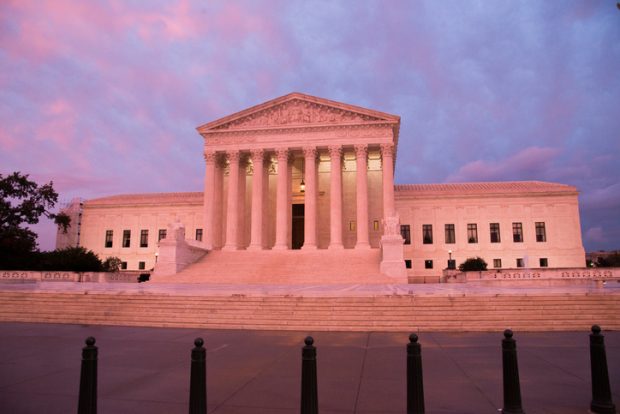
Photo Credit: Gaston Kroub, Supreme Court, Patent Saviors?, Above the Law (June 13, 2017), https://abovethelaw.com/2017/06/supreme-court-patent-saviors/.
Authored by: Naomi Baltins
The Supreme Court’s forthcoming decision in Trump v. Slaughter has the potential to become one of the most consequential separation of powers rulings in modern administrative law.[1] The case asks whether Congress may continue to protect members of independent agencies, such as the Federal Trade Commission, from presidential removal except for cause. The Court heard oral argument in December 2025 and has not yet issued an opinion. Depending on how broadly the Court rules, the decision could either reaffirm nearly a century of precedent or significantly reshape the structure of the federal administrative state.
Congress created the Federal Trade Commission in 1914 as an independent, multimember agency charged with regulating unfair methods of competition and consumer protection.[2] Commissioners serve fixed seven-year terms and may be removed by the President only for inefficiency, neglect of duty, or malfeasance in office.[3] The Supreme Court upheld this structure in Humphrey’s Executor v. United States in 1935.[4] That decision has long served as the doctrinal foundation for the modern administrative state by recognizing that Congress may impose for cause removal protections on officials serving in independent agencies. Over time, the decision has been treated as a cornerstone for agencies whose members serve fixed terms and are insulated from day-to-day political control.
In March 2025, President Donald Trump removed FTC Commissioner Rebecca Kelly Slaughter without alleging any statutory cause.[5] The termination message stated that her continued service was inconsistent with the administration’s priorities.[6] Slaughter filed suit, arguing that the removal violated the FTC Act and longstanding Supreme Court precedent.[7] The U.S. District Court for the District of Columbia agreed and ordered her reinstatement, concluding that the President failed to provide the statutorily required cause for removal.[8] After emergency appeals and stays, the Supreme Court granted certiorari and allowed the case to proceed on an expedited timeline.[9] The case now presents a fundamental issue about the structure of the federal government and the balance of authority between Congress and the President.
The government’s argument rests on a strong reading of Article II.[10] It contends that the Constitution vests all executive power in the President and that the removal of executive officers is an essential component of that authority. The Solicitor General urged the Court to overrule Humphrey’s Executor, describing it as an outlier that conflicts with more recent separation of powers decisions.[11] The government emphasizes that the FTC exercises core executive functions such as investigation, enforcement, rulemaking, and litigation. Because FTC commissioners wield executive power, the President must have the ability to remove them at will. The administration frames the issue as one of democratic accountability, arguing that agency officials who exercise significant governmental authority should ultimately be answerable to the President, who is accountable to voters.[12]
The government’s position also builds on the Court’s recent trajectory. Decisions involving the Public Company Accounting Oversight Board and the Consumer Financial Protection Bureau have narrowed the scope of permissible removal protections and treated Humphrey’s Executor as an exception rather than the rule.[13] If the Court continues along that path, it could further expand presidential control over administrative agencies.
Slaughter’s position relies heavily on precedent and historical practice.[14] For nearly ninety years, Humphrey’s Executor has permitted Congress to create independent multimember agencies with for-cause removal protections.[15] The district court emphasized that this precedent remains controlling unless the Supreme Court expressly overrules it. Slaughter also argues that Congress has broad authority under Article I and the Necessary and Proper Clause to structure federal agencies.[16] If Congress can create offices and define their duties, it should be able to determine the conditions under which those officers may be removed.
Supporters of independent agencies argue that insulation from direct political pressure is necessary for agencies that perform quasi-judicial and quasi-legislative functions. The FTC was designed to be bipartisan and expert driven. Multi-member commissions are intended to encourage deliberation, compromise, and stability in policymaking. They are also meant to prevent abrupt policy swings that might occur if leadership changed immediately with each new administration. Allowing at-will presidential removal could undermine these structural goals and transform independent commissions into more explicitly political bodies.
There are also broader institutional concerns. Many federal agencies rely on the same framework established by Humphrey’s Executor. A decision expanding presidential removal authority could affect agencies such as the National Labor Relations Board, the Equal Employment Opportunity Commission, and other regulatory bodies that operate with multimember leadership protected by for-cause removal provisions.[17] Frequent leadership changes could affect regulatory stability, enforcement priorities, and compliance expectations across multiple industries.
Recent commentary also emphasizes the real-world consequences of the Court’s potential ruling.[18] Some observers note that disputes over appointments and removals already affect agency functioning. Confirmation blockades, leadership vacancies, and political disputes have at times left agencies without a quorum or without clear leadership. Expanding presidential removal power could intensify these dynamics by allowing Presidents to remove holdover officials while facing delays in confirming replacements. In that scenario, agencies might operate without full leadership or with reduced capacity, potentially affecting their ability to implement congressional mandates.
At the same time, others argue that stronger presidential control could allow elected administrations to implement their policy agendas more effectively.[19] From that perspective, removal protections can prevent newly elected Presidents from directing agencies consistent with the policies on which they campaigned. The case, therefore, reflects a deeper debate about whether independent agencies enhance stability and expertise or whether they undermine democratic accountability.
The Court could resolve the case in several ways. One possibility is that it reaffirms Humphrey’s Executor and upholds the FTC’s removal protections. Under this approach, the justices would likely distinguish recent cases involving single director agencies and maintain that multimember commissions remain constitutional. This outcome would preserve the current structure of independent agencies and maintain limits on presidential removal authority in this context. It would also signal stability and continuity in administrative law.
A second possibility is that the Court narrows but does not overrule Humphrey’s Executor. The justices might uphold the FTC’s structure while clarifying limits on when Congress may restrict removal. The Court could adopt a functional approach that evaluates whether an agency primarily exercises executive, legislative, or adjudicative functions. This incremental path would likely invite additional litigation because agencies that exercise substantial executive authority could face future challenges. The administrative state would remain intact but subject to increased scrutiny.
The most sweeping outcome would be for the Court to hold that Congress cannot impose for-cause removal protections on principal officers who exercise executive power. Such a decision would effectively overrule Humphrey’s Executor and allow the President to remove FTC commissioners at will. The impact would be significant. Independent agencies across the federal government could be affected, and presidential control over regulatory bodies would expand. Congress might need to redesign agency structures to comply with the Court’s ruling. This result would represent a major shift toward a stronger unitary executive theory and could reshape administrative governance for years to come.
The case highlights an ongoing constitutional tension between presidential control and congressional authority to structure agencies. Recent Supreme Court decisions show increasing skepticism toward broad removal protections, yet several justices expressed concern during oral argument about the consequences of sweeping changes. The Court’s decision will likely determine not only the future of the FTC but also the stability of independent agencies more broadly. A narrow ruling could preserve the existing framework, while a broad ruling could transform it.
Trump v. Slaughter ultimately asks who controls the administrative state. A decision reaffirming existing precedent would preserve nearly a century of law. A decision narrowing or overruling that precedent could expand presidential authority and alter the balance of power between Congress and the executive branch. Whatever the outcome, the Court’s ruling will shape the structure of federal agencies and the scope of presidential power for years to come.
[1] Trump v. Slaughter, No. 25-332 (U.S. argued Dec. 10, 2025).
[2] Federal Trade Commission, About the FTC, https://www.ftc.gov/about-ftc.
(last visited Mar. 8, 2026).
[3] 15 U.S.C. § 41.
[4] Humphrey’s Ex’r v. United States, 295 U.S. 602 (1935).
[5] Slaughter v. Trump, 791 F. Supp. 3d. 1, 8 (D.D.C. 2025).
[6] Id.
[7] Id. at 6.
[8] Id. at 29.
[9] Trump v. Slaughter, 222 L.Ed.2d 1233 (U.S. 2025).
[10] Transcript of Oral Argument at 3, Trump v. Slaughter, No. 25-332 (U.S. argued Dec. 10, 2025).
[11] Id. at 3-4.
[12] Id. at 32, 53.
[13] Isabela Gibson, Trump v. Slaughter and the Potential Impact on Agency Independence, Employment Law Worldview (Jan. 06, 2026), https://www.employmentlawworldview.com/trump-v-slaughter-and-the-potential-impact-on-agency-independence-us/.
[14] Transcript of Oral Argument at 73-74, Trump v. Slaughter, No. 25-332 (U.S. argued Dec. 10, 2025).
[15] Slaughter v. Trump, 791 F. Supp. 3d 1, 14 (D.D.C. 2025).
[16] Transcript of Oral Argument at 120, Trump v. Slaughter, No. 25-332 (U.S. argued Dec. 10, 2025).
[17] Graham Steele, The Real-World Realities Confronting the Court in Trump v. Slaughter, Yale J. on Regul.: Notice & Comment (Feb. 14, 2026), https://www.yalejreg.com/nc/the-real-world-realities-confronting-the-court-in-trump-v-slaughter-by-graham-steele/; Isabela Gibson, Trump v. Slaughter and the Potential Impact on Agency Independence, Employment Law Worldview (Jan. 06, 2026), https://www.employmentlawworldview.com/trump-v-slaughter-and-the-potential-impact-on-agency-independence-us/; Terra Silva, Supreme Court Soon to Revisit President’s Authority to Remove Members of Independent Agencies, Maynard Nexsen (Nov. 2025), https://www.maynardnexsen.com/publication-supreme-court-soon-to-revisit-presidents-authority-to-remove-members-of-independent-agencies.
[18] Id.
[19] Terra Silva, Supreme Court Soon to Revisit President’s Authority to Remove Members of Independent Agencies, Maynard Nexsen (Nov. 2025), https://www.maynardnexsen.com/publication-supreme-court-soon-to-revisit-presidents-authority-to-remove-members-of-independent-agencies.
 American Journal of Trial Advocacy