Do Your Second Amendment Rights Cease at the End of Your Driveway?

By: Charlie Hearn

Executive Editor, American Journal of Trial Advocacy

Do you feel safer at home or in public?  Most people probably answered, “of course I feel safer at home.”  A home offers the opportunity to take necessary precautions to ensure one’s safety; including, in addition to keeping firearms, locking doors and windows, installing an alarm system, installing cameras or motion sensor lights, and even putting up fences, walls, and gates.  Security measures such as these allow individuals to monitor and control what takes place around them at their home.  However, when a person is away from their home, they are without many, if not all, of these security measures.  Once outside of their home, people are no longer able to control who they come in contact with, or what security measures are in place.  These facts drive millions of Americans each day to carry, whether concealed or open, a firearm in public.  However, is this right protected under the Second Amendment? Continue reading “Do Your Second Amendment Rights Cease at the End of Your Driveway?”
No Constitutional Right to Affordable Bail – Where Do We Go From Here?

By: Jonathan Brown
Member, American Journal of Trial Advocacy

Contrary to popular belief, the United States Constitution does not guarantee a right to affordable bail.[1] In an attempt to avoid locking people up because of their lack of wealth, a person is guaranteed the right to have their bail reviewed by a judge.[2] A hot-button issue for many courts arises when bail schedules automatically apply a specific bail for a given offense. Continue reading “No Constitutional Right to Affordable Bail – Where Do We Go From Here?”

Must Police Have a Search Warrant Before They Can Compel Mobile Phone Service Providers to Turn Over Data That Pinpoints a Suspect’s Physical Movements?

By: Jacey Mann

Student Materials Editor, American Journal of Trial Advocacy

With the “drop” of the new iPhone 8, and with the Android companies ever competing to stay “the best in the industry,” technology is advancing at miraculous speeds. Further, with companies, employers, and other business ventures hopping on the “social media train,” our generation is not only encouraged, but rather nearly forced to always have their smartphones with them. As children, and even as adults, we are cautioned to “be careful what you post on the Internet,” and constantly reminded that what gets posted will live on forever. But until recently, there has been little done about encouraging people to “hide” their “locations.” Continue reading “Must Police Have a Search Warrant Before They Can Compel Mobile Phone Service Providers to Turn Over Data That Pinpoints a Suspect’s Physical Movements?”

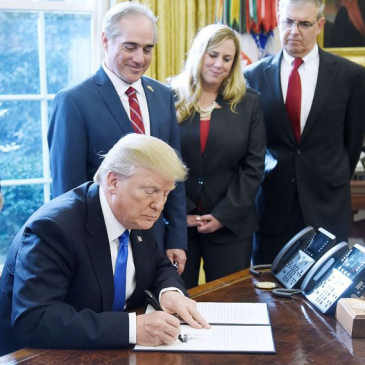
Executively Ordering the Prioritization of Veterans’ Mental Health

Photo Credit: Stripes.com, Olivier Douliery

By: Averie L. Armstead
Member, American Journal of Trial Advocacy

On January 9, 2018, President Donald Trump signed an executive order directing the Departments of Defense, Veterans Affairs, and Homeland Security to develop a plan that ensures all uniformed service members transitioning into civilian life have access to mental health treatment and suicide prevention resources for at least one year immediately following their separation from the military, whether discharged or retired.[1] By March 9, 2018, the departments must submit a Joint Action Plan outlining “actions to provide … seamless access to mental health treatment and suicide prevention resources for transitioning uniformed service members.”[2] The order’s focus is to ensure that the 60 percent of veterans who currently do not qualify for care – due to lack of verified service-related requirements – can receive the treatment “they so richly deserve.”[3] Continue reading “Executively Ordering the Prioritization of Veterans’ Mental Health”

To Speak, or Not to Speak: Is Silence a Breach of Fiduciary Duty?

Photo Credit: News.ArtNet.com, Sarah Cascone

By: Anthony Anello
Member, American Journal of Trial Advocacy

The infamous rule 10b-5, better known as the “Employment of Manipulative and Deceptive Practices” act, was created in an attempt to make investing in securities safer.[1] Rule 10b-5 of the Securities Exchange Act of 1934 deems it illegal Continue reading “To Speak, or Not to Speak: Is Silence a Breach of Fiduciary Duty?”

302 Pages of Hope

“Hope is a good thing, maybe the best of things, and no good thing ever dies.” The Shawshank Redemption (Castle Rock Entertainment 1994).

Senior Research and Writing Editor: Amanda L. B. Wineman

302 pages. 302 pages is what it took District Court Judge Myron Thompson to fully explain his ruling in Braggs v. Dunn.[1] He wrote 302 pages detailing the inadequacies and failures of the Alabama Department of Corrections (ADOC) in providing mental health care to its prisoners.[2] In a multi-faceted set of cases, the Southern Poverty Law Center, along with attorneys from other Alabama firms, brought suit on behalf of a class of prisoners from fifteen ADOC facilities against ADOC.[3] The first phase involved American Disability Act (ADA) claims that ADOC discriminated on the basis of physical disabilities and that they failed to make accommodations for disabilities.[4] Continue reading “302 Pages of Hope”

Could Rondini Spark Reform for Rape Laws?

By Mallory Bullard, Senior Research and Writing Editor

Ask yourself, “What do rape cases have in common?” Many responses might be racing through your mind. You may be thinking of words such as: victim, consent, or maybe even force. While those words are all associated with rape cases, the uniqueness of the crime is a commonality that is often overlooked. Rape is distinguishable because “[n]o other violent crime is so fraught with controversy, so enmeshed in dispute and in the politics of gender and sexuality.”[i] Continue reading “Could Rondini Spark Reform for Rape Laws?”

Improper Grammar and Our Modern-Day Vernacular Collide Raising Questions About Whether One Louisiana Man’s Fifth Amendment Rights Were Violated

Photo Credit: Jeff Reeves, WATE CBS North Carolina

By: Holly Howell

Editor-in-Chief, American Journal of Trial Advocacy

“If y’all, this is how I feel, if y’all think I did it, I know that I didn’t do it so why don’t you just give me a lawyer dog ‘cause this is not what’s up.”[1]  This request, made by then-22-year-old Warren Demesme, may seem straightforward on its face, but it has proved controversial, requiring Louisiana law enforcement and, later, the Louisiana Supreme Court to analyze Demesme’s vernacular, what he was actually asking for, and whether or not his Constitutional rights were violated.  The Court’s decision may now have serious implications—both for Demesme, who is potentially facing time in prison, as well as for those accused and interrogated in the future. Continue reading “Improper Grammar and Our Modern-Day Vernacular Collide Raising Questions About Whether One Louisiana Man’s Fifth Amendment Rights Were Violated”

When Involuntary Becomes Voluntary: The Uncertainty of Protection Against Involuntary Confessions

Photo Credit: https://www.johntumeltycriminaldefense.com/blog/confession-offers-leniency/involuntary-confession/

Written by: Alexandria Heard

Associate Student Materials Editor, American Journal of Trial Advocacy

            The story behind Dassey v. Dittmann is no secret to the American people. In the widely popular Netflix series, Making a Murderer, the producers delve into the life of Brendan Dassey and the untimely murder of Teresa Halbach. The following facts are as depicted by the United States Court of Appeals for the Seventh Circuit after a long, arduous procedural history in relation to Petitioner Dassey’s videotaped confession to participating in the rape, murder, and mutilation of Halbach.[1] Continue reading “When Involuntary Becomes Voluntary: The Uncertainty of Protection Against Involuntary Confessions”

The Death Penalty and the Terminally Ill – What Happens After a Botched Execution?

Photo Credit: usnews.com

By: Suzanne Norman

Member, American Journal of Trial Advocacy  

On February 22, 2018, following 31 years of legal battles, Lee Doyle Hamm was sentenced to death by a Cullman County jury.[1] The State of Alabama attempted to administer its combination of lethal drugs to Hamm, but doctors were unable to successfully locate a vein to insert the needle before the attempt was called off.[2] After the United States Supreme Court lifted a temporary stay that allowed for the execution of Hamm, the people tasked with administering the drugs to Hamm attempted at least 11 times to locate a vein that would allow the drugs to be introduced to Hamm’s system, leaving Hamm bruised and bloody.[3] Continue reading “The Death Penalty and the Terminally Ill – What Happens After a Botched Execution?”